
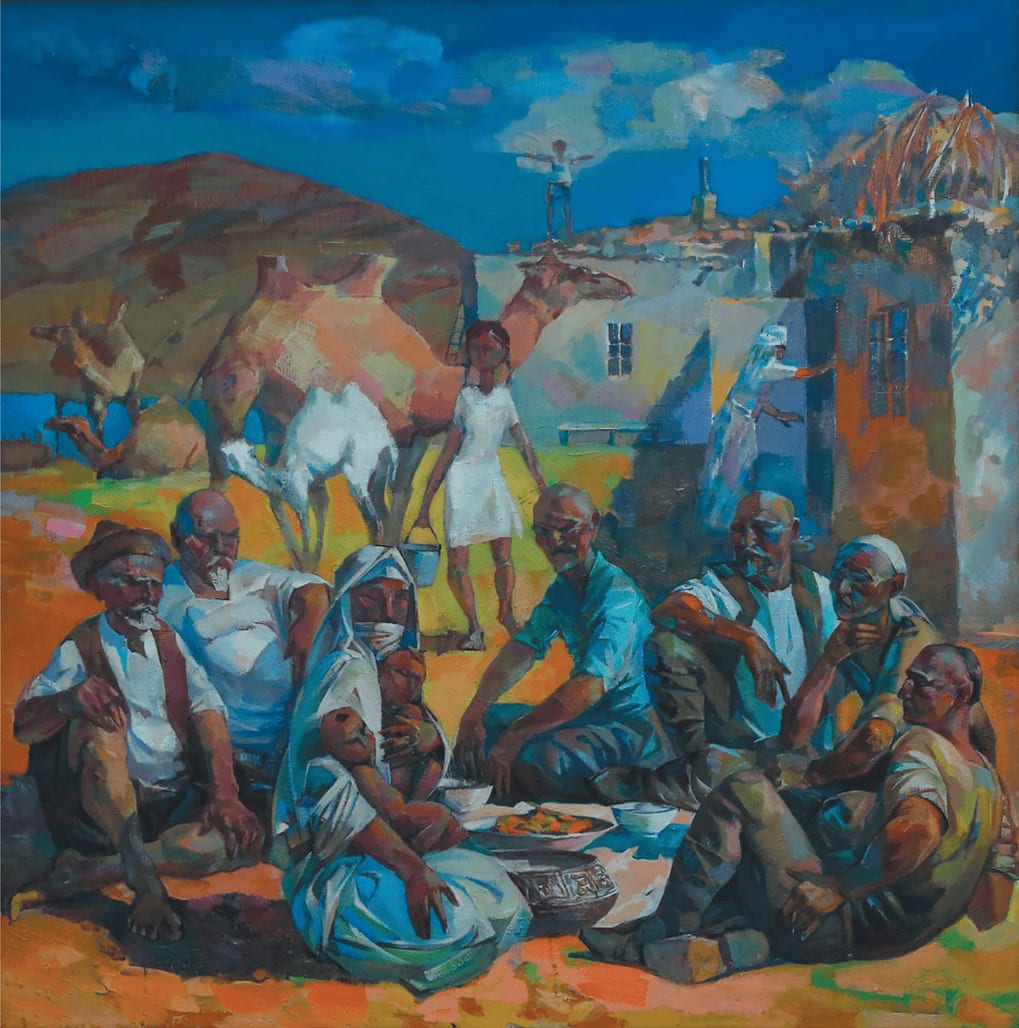
This diptych by Ali is among his best works. The village holds a unique significance for Kazakhs—it is the cradle of national spirit and the true embodiment of Kazakh identity. The village represents a rich wellspring of customs, traditions, worldview, and language. The scent of sagebrush, the smoke from the village hearth, the soil, rocks, the scorching heat of the steppe, the evening breeze, and the village elders are all symbols of Kazakh existence. Therefore, it is natural that the artist chose this theme, which was so close to his heart.
The development of the village theme in art is driven by a deep understanding of even a small part of life, memories, careful observation of the surroundings, and visual recollection. In a typical situation, the artist creates events and characters. The work "At the Hearth" is dedicated to village women. It is a simple depiction of rural life, with young women chatting around the hearth. The smoke from the hearth symbolizes peace and prosperity. For those who grew up in a village, this exotic scene is very familiar. The artist expresses something universal in a convincing and emotional way. People familiar with village life will recognize the authenticity of this scene, based on nature's reality. The village, for those who understand it, is a world full of beauty and special qualities. The artist never tires of admiring the beauty and authenticity of life on Earth. Thus, his artwork masterfully brings to life this marvelous world in all its beauty using the highest qualities of visual art—lightness, weight, density, clarity, richness of colors, and harmony.
The second piece, titled "At the Table" (the second diptych), depicts village elders and wise men sitting around a table, drinking shubat (fermented camel milk) and talking. In the background, a girl is shown carrying a bucket, having milked a camel. In the far background, a child is seen on the roof of a small house. The artist does not depict his feelings or perceptions, but rather conveys his ideas about the world. It could be interpreted as nostalgia for childhood, as the artist translates emotions and memories directly into a visual form. This is already a generalization of certain facts, yet the power of this generalization lies not in abstract thought but in the imagination and artistic representation, which reflect a person's relationship with these facts. Memory helps to fill in the missing details and bring separate experiences together into a unified image. The generalized depictions of familiar rural events are something that everyone who grew up in a village can relate to. This reflects Ali's remarkable ability to think artistically. His life experience is expressed emotionally, with a deep understanding of what he has seen and learned, and he uses this understanding to create vivid images.
Each image evokes in the viewer a series of thoughts, reflections, and conceptual insights. Ali's deep reflection on the phenomenon of the village is one of the most important works in the development of Kazakh visual art.
One of the favorite scenes is the village. There are also simple scenes of everyday life, familiar from childhood: early in the morning and late in the evening, women are busy at the hearth. And compositions seeking to have deep meanings. As it happened in the diptych “Aul”, where in the left part “Near the hearth” nine women of different ages with small children are standing, sitting, lying around one stove. One of them (in the foreground) is breastfeeding a baby. Another one bent over the cauldron to taste the food. And here's a funny detail: a baby is sleeping on her back, tied to her body with a white cloth. The images are inscribed in a sort of triangle with a wide base, and this confirms the stability of this world. The right part of the “Set table” is assigned to men who returned from pastures and settled on the ground around the dastarkhan. Everyone has relaxed poses. They are having a well-deserved rest. In the foreground there is a woman with a baby. She is looking at the viewer. Her sacred duty is to be the hostess of the dastarkhan and pour koumiss, tea, soup into bowls. In both compositions there are accompanying details of the background: a boy on a horse, a girl with a yoke, a camel with a colt, a girl with a small bucket and, of course, a rural adobe house. In this tightly-knit world, everything goes on as usual, without fuss and shifts of the traditional manner of things.
In this regard, it is important to mention his famous scenes of village life depicting women at the hearth and men at the table. These scenes are from his childhood became a symbol of the images and memories he received. These works show the author's deep understanding of Kazakh life, his desire to convey the spirit and energy of Kazakh culture through his art.


