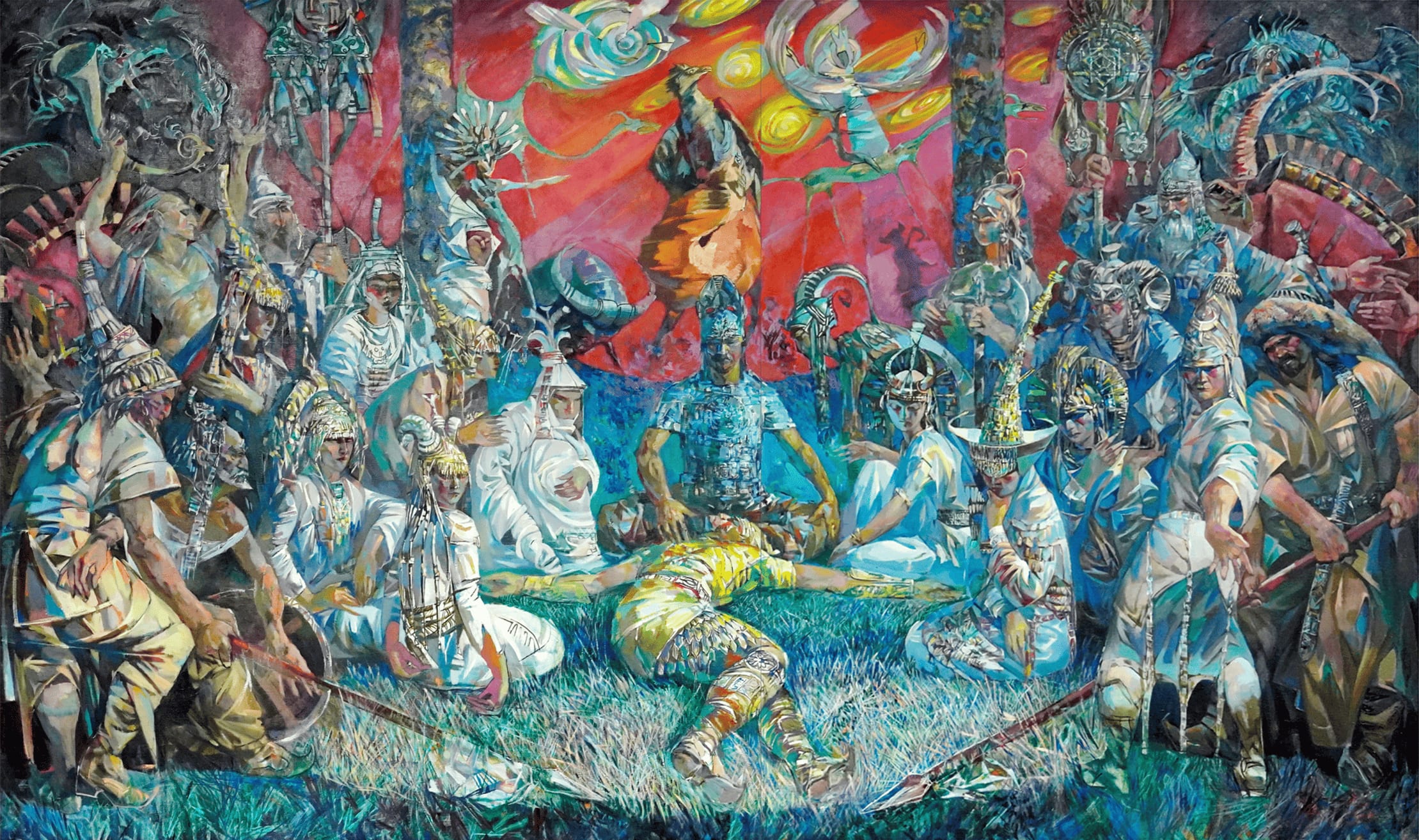
Ali, who poured his talent, time, and energy into this wonderfully crafted piece, will leave no viewer indifferent. The visual representation and its emotional impact are astonishing. Moreover, its intellectual significance is profound. The artist has depicted the mysterious secrets of the human phenomenon, created from 'body, soul, and spirit.' He has likened the world where our ancestors and Tengri (the Sky God) lived to a mystical realm. The three works are filled with ethno-information that leads the viewer toward the horizon of mythical and folkloric understanding, uniting them in a single flow. The folkloric theme of death, a complex topic that few dare to address, is presented here. However, instead of focusing on tragedy, the work emphasizes epic power, effectively conveying the history and worldview of the people.
Major Works: Funeral. 150x250 cm. 2019. Yellow Sound. 80x100 cm. 2017. Melody. 144.5x145 cm. 2015
These are some of Ali's most remarkable works that have entered the golden collection of Kazakh art. Each of these pieces took two years to complete, undergoing numerous sketches and explorations. His works possess a mystical intuition and an endless thought process. The creative journey behind these pieces reflects a deep exploration of cosmic and eternal themes, including the relationship between the soul and body, and life and death.
The piece “Requiem”, created in 2019 with a size of 150x250 cm, is born from deep philosophical thought and is one of Ali's finest works. During his lifetime, we often spoke of how this piece came from a brilliant idea.
In the background, the red mystical sky, tombstones shaped like 'syntas' (ritual stones), various shamanic symbols, and cosmic mysteries with sun-like figures emphasize the theme, adding to its enigmatic content. In the center, a leader sits cross-legged, and next to him, a lifeless warrior lies still, immediately catching the viewer's attention. The most striking aspect of the painting is the ethnographic clothing, each designed with exceptional artistic solutions, showcasing rich folklore. You see the ancient horned Saka horse, a warrior wearing a ram-horned helmet, horned headgear, and various types of saukele (traditional headdresses). The two warriors in the foreground lowering a spear with flags are adorned in particularly impressive headgear.
The artist seems to have wanted to depict the ritual or traditional religious ceremony through this scene. However, it's not just about these figures; the artist has skillfully crafted the balance of the composition, ensuring the harmony of colors. The history of many remarkable works confirms that for a painting to achieve unity, the optical and narrative centers must align, which is one of the fundamental principles of art composition. Although the scene is overloaded with figures on the sides, the central characters still hold the viewer's attention. The poetic melody in this composition is highly inventive. In this way, Ali has achieved unity. Wherever the artist worked, he did not depict random fragments of life but conveyed a broad, holistic view of reality. In the process of choosing a central character, the role of creative imagination was of paramount importance. He combined the astonishing real world with the mystical, transforming individual elements into a unified artistic image. He accepted the relationship between body, soul, and spirit as a single concept, providing a deep understanding of our ancestors' spiritual nature and their philosophy of life.
Ali Bakhtygerey as an artist and thinker finds his inspiration in the phenomenon of "Turan". He perceives "Turan" not only in a geographical and historical context, but also as an existential space in which the Kazakh soul acquires form and color. The result of this search is his symbolic-philosophical apotheosis - the painting "Janaza" (requiem). The painting "Janaza" (requiem) is a very important event in the creative career of Ali Bakhtygerey. This is a work inspired by Dante Alighieri's literary work "Mighty Comedy" translated into Kazakh by Mukaghali Makatayev. The artist combined the philosophical and cultural aspects of Turan in this work in a multi-figure composition enriched with mythological and shows folklore images. Its epic power, the work holds the viewer's attention and allows him to return to the center of the composition. Each element connects past and the present, creating a deep philosophical context based on Kazakh cultural traditions, attitudes towards life and death.


